Discover how converging physical and cybersecurity reduces breach costs, improves operational efficiency, and delivers measurable ROI that turns security into a business enabler.

For decades, organizations have treated physical security and cybersecurity as separate disciplines — managed by different teams, budgets, and technologies. That division no longer reflects reality.
Today’s threats cross seamlessly between the physical and digital worlds. A compromised badge reader can open the door to a data breach. A hijacked camera network can become a foothold for ransomware. A phishing email can lead to unauthorized facility access.
At Harris Technology Services (HTS), we’ve seen leading enterprises achieve measurable value by converging these two disciplines. This integration not only strengthens protection — it produces tangible financial, operational, and strategic benefits that shift security from a cost center to a driver of business performance.
According to IBM’s 2024 Cost of a Data Breach Report, the average breach costs $4.88 million — a 15% increase over three years. Meanwhile, the average cost of a physical security breach (such as insider theft or sabotage) averages $870,000 per incident (Allied Market Research, 2023).
Yet, the most damaging events are hybrid — those that combine physical intrusion with digital compromise. These “blended threats” are growing 20% year-over-year (Gartner, 2024).
Frameworks like NIST 800-82, ISO 27001, and CISA’s Physical Security Performance Goals now explicitly emphasize integrated governance. Boards and regulators expect holistic enterprise risk management, not departmental silos.
The convergence of physical and cyber security is no longer optional — it’s a financial and compliance necessity.
When physical and cyber protections operate in concert, organizations unlock measurable business value across four major dimensions:
Here’s a practical ROI model you can adapt:
Below is an illustrative model (replace with your own numbers):
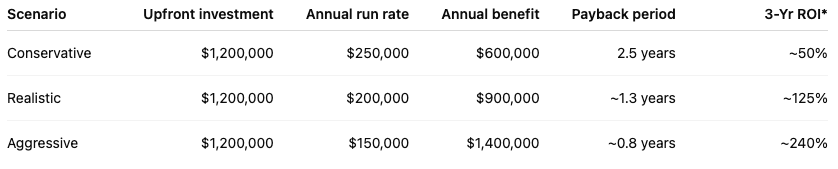
* 3-Year ROI = (3×benefit – total 3-year cost) / total 3-year cost.
You can adopt the same framework to populate with your organization’s breach exposure, budget, staffing costs, and confidence ranges.
HTS recommends a six-step roadmap to maximize ROI while minimizing disruption:
HTS’s Converged Security Maturity Model provides a scalable framework that adapts to organizational complexity and budget.
Technology alone doesn’t sustain convergence — culture does.
To achieve lasting impact, enterprises must:
The result is an integrated risk posture that supports brand trust, compliance, and shareholder confidence.
Security convergence is no longer theoretical — it’s a proven accelerator of both resilience and financial performance.
By integrating physical and cyber operations, enterprises:
✅ Reduce hybrid threat exposure
✅ Optimize operations and insurance
✅ Demonstrate stronger governance
✅ Deliver quantifiable ROI within 12–24 months
As organizations face rising threats and scrutiny, convergence stands as both a risk management imperative and financial opportunity.
📩 Visit www.hts.pro
🔗 Connect with Joshua D. Holmes, Chief Revenue Officer, on LinkedIn
Harris Technology Services (HTS)
Nationwide Security & IT Provider — delivering convergence-driven protection and performance.
Connect with us to explore our scalable solutions tailored to your unique needs and receive a personalized free quote.